Wet Basement Fixes

Winston-Salem basement waterproofing

Basement Waterproofing in Winston-Salem, NC

Winston-Salem homeowners deal with basement water more often than most of North Carolina, simply because far more homes here have basements at all. That changes what is worth checking first and what local help exists.

Forsyth County and the northwest Piedmont

Before requesting local help

  • Document the first wet point and storm timing.
  • Check outside drainage near the same wall.
  • Review sump pump behavior and discharge location.
  • Ask what local drainage or permit questions may apply.

Last reviewed: August 30, 2026

Local answer

What Winston-Salem homeowners should check first

Winston-Salem is the basement capital of North Carolina. Roughly 36% of homes in Forsyth County have a basement, against about 6% in Wake County and 3% in Durham. That means basement water here is an ordinary maintenance problem rather than an unusual one, and there is a deeper pool of local contractors who work on basements specifically.

The diagnostic sequence is the same as anywhere: find where water first appears inside, then look at what is happening outside that same wall. Roof water, downspout length, grading, patios, and window wells decide how much water arrives at the foundation before any interior system is asked to handle it.

Winston-Salem also runs something most North Carolina cities do not. The City operates a 70/30 drainage assistance program in which it covers 70% of the cost of qualifying drainage repairs on private property. It does not apply to every wet basement, and it is a drainage programme rather than a waterproofing one, but it is worth asking about before paying for exterior water work in full.

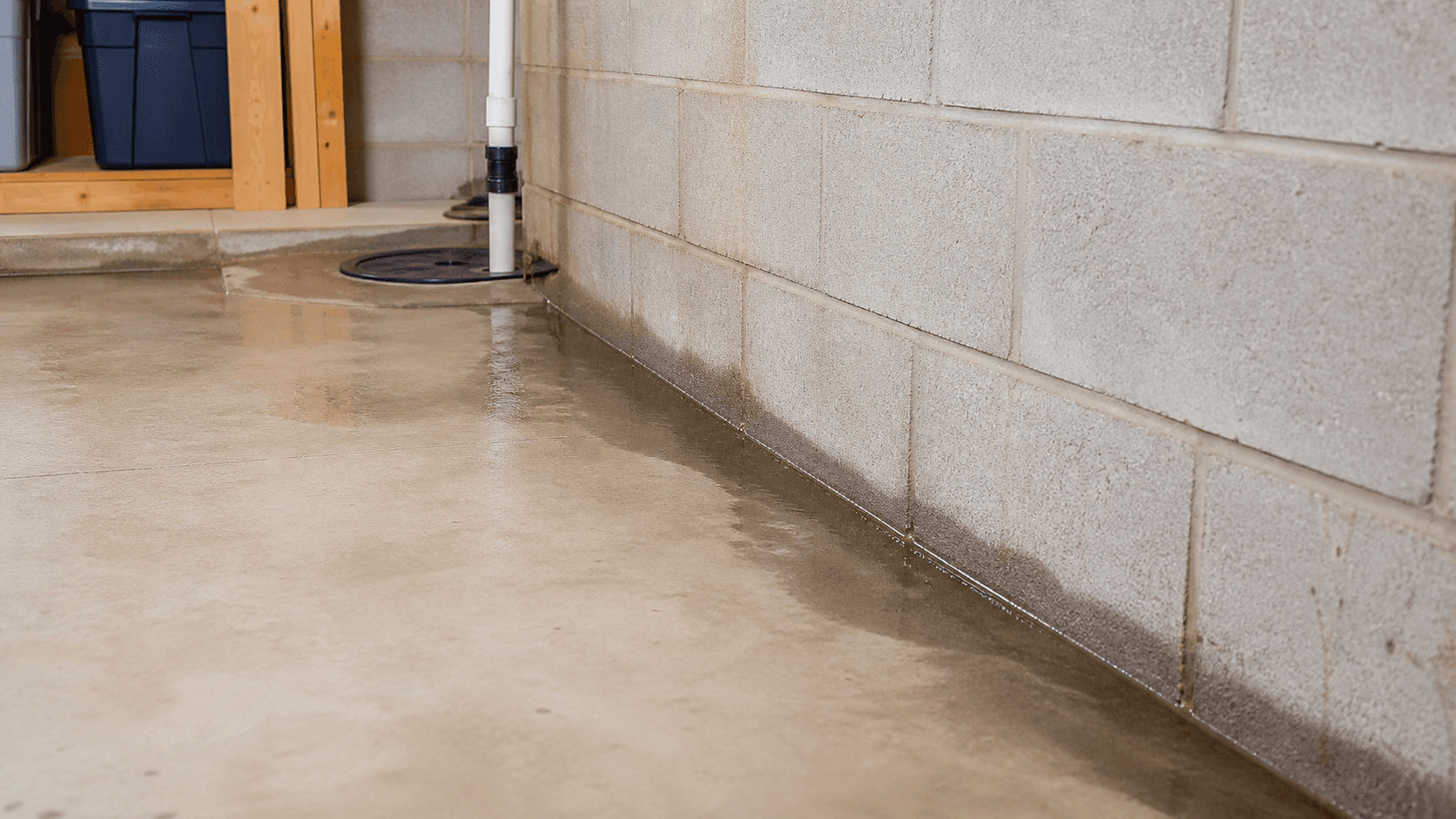
Water appearing at the joint between a basement wall and floor after rain
In Winston-Salem, the wall-floor joint is a common first wet point, and it usually points to water collecting outside the footing rather than a wall leak.

Local context

Winston-Salem drainage and waterproofing context

The high basement share in Forsyth County is the single most useful local fact for a homeowner here. It means comparable work is common, more contractors carry genuine basement experience, and neighbours are more likely to have had the same problem. It also means more finished basements, and therefore more at stake when water arrives.

The City of Winston-Salem 70/30 program shares the cost of qualifying private-property drainage repairs, with the City covering 70%. Homeowners should confirm current eligibility, scope, and funding directly with the Stormwater Division rather than relying on a contractor's summary of it, and should understand that drainage assistance and basement waterproofing are not the same scope.

As in the rest of the Piedmont, native soils are largely clay. Clay drains slowly and holds water against foundation walls after heavy rain, which is why hydrostatic pressure at the wall-floor joint is a recurring pattern rather than a one-off failure.

Winston-Salem should be treated as the site's primary local hub for basement work. Pages here should not claim offices, crews, reviews, or response times unless those details are real and documented.

How to think locally

City name is not enough: match the water path

Local waterproofing decisions work best when the inside symptom is matched to outside water conditions. The first wet point, storm timing, sump behavior, discharge route, downspout layout, grading, nearby hard surfaces, window wells, and finished materials all matter more than the city name by itself.

Local drainage rules are not the same as a basement repair quote. A waterproofing contractor may be able to install interior drains, sump systems, crack repair, exterior membranes, or discharge improvements, but city stormwater programs usually focus on public drainage systems, floodplain rules, right-of-way conditions, or development requirements. Homeowners should ask which part of the problem is private-property maintenance and which part involves public drainage or permits.

Before hiring, homeowners should verify any contractor's local office, service area, licensing, insurance, response time, completed work, and references. A strong estimate explains the water source, repair limits, drainage route, warranty conditions, and what is excluded from cleanup or restoration.

For finished basements, the local estimate conversation should include water control, cleanup boundaries, finished-wall access, flooring, sump backup, alarms, discharge location, and whether the basement should be tested through repeat rain before repairs are covered again.

Before an estimate, keep a simple rain log for at least one or two storms when possible. Note when rain started, when water appeared, where the first wet mark formed, whether the sump pump ran, where discharge flowed, and what changed outside the same wall. Photos taken before cleanup often make the estimate more accurate than a dry-basement walkthrough days later.
Homeowner scenarios

Common Winston-Salem waterproofing situations

Finished basement in an older neighbourhood

Many Winston-Salem basements are finished living space in homes built long before modern exterior drainage. The estimate should say what has to be opened to find the leak path, what gets dried and tested, and what restoration is excluded before the work is priced.

Water at the wall-floor joint after storms

Water appearing along the cove joint usually means water is collecting outside the footing rather than passing through the wall face. Ask whether the proposal collects water at the footing, reduces the water arriving outside, or both.

Considering the city drainage program

If the water problem is clearly exterior — a drainage route, a low area, runoff crossing the property — it may be worth asking the Stormwater Division about the 70/30 program before commissioning private exterior work. Confirm eligibility yourself; do not rely on a sales claim.

Buying a home with a basement

With basements this common locally, an inspection should include the basement specifically: staining lines, efflorescence, sump presence and age, discharge routing, and whether past repairs were cosmetic or structural.

Common symptoms

Basement water problems to document in Winston-Salem

Hydrostatic pressure at the joint

Clay soil holds water against the wall after rain, and the wall-floor joint is the easiest path in.

Roof water arriving at the foundation

Short downspout extensions concentrate roof water exactly where the basement is least able to cope.

Aging or absent sump systems

Older basements may have no sump at all, or a pump well past its service life with no backup or alarm.

Finished-wall concealment

Finished basements hide the leak path, so the wet spot you see is often not where water enters.

Inspection focus

What a Winston-Salem estimate should verify on site

Match inside to outside

Identify the first wet point indoors, then inspect grading, downspouts, patios, and window wells on that same wall.

Sump and discharge

Check basin, pump age, check valve, backup power, alarm, and where discharge water actually ends up.

Whether it is drainage or waterproofing

Exterior water routing problems and basement waterproofing are different scopes with different remedies and different funding routes.

Services

Which waterproofing option may fit the pattern?

Interior basement waterproofing

Often fits water at the wall-floor joint, recurring perimeter seepage, or basement edges where water needs to be collected and routed to a sump basin. Ask how many linear feet are included, how wall water enters the drain, and what happens during power loss.

Exterior basement waterproofing

May fit wall-side water, failed exterior drainage, or a wall that needs source-side repair. Ask what will be excavated, how utilities and hardscapes are protected, what membrane or drainage board is included, and what surfaces are restored.

Basement drainage systems

Useful when water needs a controlled collection path. Interior drains, exterior footing drains, and French drains should be compared by location, depth, discharge, sump connection, maintenance, and restoration.

Sump pump installation

Important when water collects in a basin or an interior drainage system needs powered discharge. Ask about pump capacity, basin condition, check valve, alarm, battery backup, secondary pump, electrical needs, and discharge termination.

Basement crack repair

A good fit when water follows a specific crack or penetration and the wall is stable. Ask whether injection, exterior repair, or drainage correction is being recommended and whether structural movement is excluded.

Exterior water management

Gutters, downspouts, grading, window wells, patios, and discharge lines can add water to the foundation. NC State Extension guidance emphasizes keeping roof water moving away from foundation walls.

Costs and estimates

What can change a Winston-Salem waterproofing quote

Cost factors

  • Interior perimeter drain length, number of affected walls, concrete removal, and finished-wall access.
  • Sump basin, pump, backup power, alarm, check valve, and discharge routing to a point that does not recycle water back.
  • Exterior correction: downspout extension, regrading, window-well drainage, and hardscape edges.
  • Finished-basement restoration, drying, and material removal, which is often excluded from a waterproofing price.
  • Whether any part of the exterior work may qualify for the City's 70/30 drainage cost share.
  • Crack repair scope where a specific path is identified, versus system-level water management.

Estimate questions

  • Where does this proposal say the water is coming from, and what evidence supports that?
  • Does it collect water at the footing, reduce water arriving outside, or both?
  • Where does the discharge end, and can it return toward the same wall?
  • Is any of the exterior scope potentially eligible for the City of Winston-Salem 70/30 drainage program?
  • What finished-wall opening, drying, and restoration is included, and what is excluded?
  • What is warranted, for how long, and what voids it?

Nearby areas

Nearby Winston-Salem areas and related searches

ClemmonsKernersvilleLewisvilleWalkertownPfafftownRural HallTobaccovilleBethania

Estimate limits

Important limits before you compare contractors

Verify any contractor's Winston-Salem office, crews, licensing, insurance, and completed local work before relying on those claims.
The City's 70/30 drainage program is administered by the City, not by contractors. Confirm eligibility and current terms with the Stormwater Division directly.
City drainage assistance and private basement waterproofing address different problems; one does not substitute for the other.
Sewage odor, contaminated water, gas smell, or electrical hazards need a safety-first response before any routine waterproofing estimate.

Related pages

Useful next pages before requesting an estimate

FAQs

Winston-Salem basement waterproofing questions

Why do so many Winston-Salem homes have basements?

Forsyth County has the highest basement share in North Carolina at roughly 36% of homes, more than double the next county. Topography and building practice in the northwest Piedmont favoured basements far more than the flatter Triangle and coastal plain, where crawl spaces and slabs dominate.

What is the Winston-Salem 70/30 drainage program?

It is a City cost-share arrangement under which Winston-Salem covers 70% of the cost of qualifying drainage repairs on private property. Eligibility, scope, and available funding are set by the City, so confirm current terms with the Stormwater Division rather than relying on a contractor's description.

Is basement water in Winston-Salem usually a wall problem or a drainage problem?

Often it is a drainage problem that shows up at the wall. Clay soils hold water against the foundation after heavy rain, so water frequently enters at the wall-floor joint under pressure rather than through the wall face. The estimate should say which it has identified and why.

Does a wet basement need interior or exterior work?

It depends on where the water is arriving and how much of it there is. Interior drains manage water that reaches the perimeter; exterior work reduces how much gets there. Many Winston-Salem basements benefit from exterior water reduction first, because it lowers the load everything else has to handle.

Sources

Local and safety references

Local context was reviewed against public stormwater, drainage, safety, and moisture-control references. Use these sources for orientation, then confirm property-specific details with the relevant professional or local office.